
10 Years of Microfluidics and Redefining Reservoir Fluid Testing
When we started Interface Fluidics in 2016, I was convinced of one thing: the Oil and Gas industry was making billion-dollar decisions without fast, accurate access to reservoir fluid data.
Reservoirs do not behave the way we assume they do. Fluids interact in complex, non-linear ways. And yet traditional laboratory workflows for reservoir fluid analysis were slow, expensive, and difficult to scale.
We believed microfluidic testing could close that gap. Ten years later, high-pressure microfluidics has become a commercial tool for flow assurance testing, Flowback testing, PVT testing, phase behaviour testing, and enhanced oil recovery screening across the global Oil and Gas sector.
Microfluidics is no longer an experimental idea. It’s practical and it’s repeatable.
Why Traditional Reservoir Fluid Testing Was Not Built for Modern Oil and Gas
The Oil and Gas industry has relied for decades on large-scale laboratory systems like core-flooding, PVT cells, and slim-tubes to evaluate fluid behaviour.
Conventional PVT testing requires bulky pressure cells and extended experimental timelines. Slim tubes and sandbox systems demand significant sample volumes. Chemical screening programs in enhanced oil recovery can take months to iterate.
These tools are technically sound, but they were not designed for speed, iteration, or visual insight. Reservoir complexity has increased, and legacy laboratory infrastructure has struggled to keep pace.

Engineering High-Pressure Microfluidics for Reservoir Conditions
Microfluidics had already transformed biomedical research. But most academic microfluidic systems were not engineered for live oil, heavy oil, supercritical CO2, or reservoir brines.
This is where we saw opportunity.
We focused on building high-pressure microfluidic testing systems capable of operating under true reservoir conditions.
Our approach combined custom microfluidic chips, high-pressure and high-temperature operation, direct optical visualization, controlled experimental environments, and reduced sample requirements.
The result was reservoir-on-a-chip technology capable of replicating key displacement mechanisms without sacrificing physical realism. Our initial customers were in the Canadian Oil Sands because Dave Sinton and I had a lot of experience working with Suncor and it is an area that needed a safe place to test out new technologies like radio-frequency aided bitumen extraction, solvent aided steam assisted gravity drainage (SA-SAGD) and alkaline SAGD. Our first year was mainly running projects for customers like Suncor and Cenovus. Before microfluidics this work would have been done either with computer simulations (difficult to use accurately for new extraction processes) or sandbox testing (very expensive and slow). This work was essential to starting up the company, building internal processes and building up our lab capabilities. The real breakthrough came with our first project in the hydraulic fracturing space.
Screening High-Temperature Foams with Microfluidics for Thermal Recovery Processes
Thomas W. de Haas, Bo Bao, Hugo Acosta Ramirez, Ali Abedini, and David Sinton
Energy Fuels 2021, 35, 7866−7873 • 2021
Thermal recovery processes, and in particular, Steam-assisted gravity drainage (SAGD), are the most common and practical in situ technology for bitumen extraction. While SAGD is effective, steam injection results in poor steam chamber growth and distribution with poor conformance specifically in areas with poor formation geology and bedding properties. These factors result in economic and environmental costs.
Stuart had had been looking south to what was happening in the shale industry in the USA since we began Interface. He made a trip to Houston in late 2016 that really started us on the road to where we are today. Testing new technologies for shale production is very difficult but for different reasons than SAGD. Shale has extremely low permeability (hard to push fluids through) which makes testing new products with real core samples practically impossible. Microfluidics and the smaller version nanofluidics, provides a way to test new chemicals with the actual reservoir fluids at temperature and pressure with representative confinement.
Novel Oil Flow Enhancement Chemistry for Unconventional Formations Evaluated and Optimized by Cutting-Edge Methodology
E. Cambre, A. Abedini, X. Zhang; K. Boyle, E. Hughes
URTEC-2019-648-MS • July 2019
The objective of this paper is to present a new innovative methodology that can be used to develop and evaluate the efficacy of enhanced flowback chemistries such as a novel oil-based surface modifier. This unique chemistry has been optimized to penetrate into the nanonetwork of formations, such as the Wolfcamp, with pore throat sizes as low as 110 nm at pressure differentials of only 225 psi, thereby demonstrating the ability to increase the volume of oil recovered during flowback by 250% and increasing the average producing flowrate by 194% during testing.
We developed and patented a method to test chemical compatibility in hydraulic fracturing and dubbed it our Flowback Test. This was our first repeatable commercial success and remains one of our most popular tests to date. We have tested chemistry with the Flowback test for clients in Canada, The USA, Oman, and Kuwait. This technology has helped many chemical companies secure large, multi-million dollar contracts to sell chemistry that is backed by impartial science and many producers to spend money on the chemical that will most aid recovery, at the right price.
Microfluidic Testing for Confident Field Decisions
Today, Interface Fluidics supports:
- Flow assurance testing for wax, asphaltenes, scale, and emulsions.
- Flowback testing to evaluate fracturing fluid compatibility and performance.
- PVT and phase behaviour testing under reservoir-representative conditions.
- Enhanced oil recovery screening for surfactants, polymers, solvents, and CO2 systems.
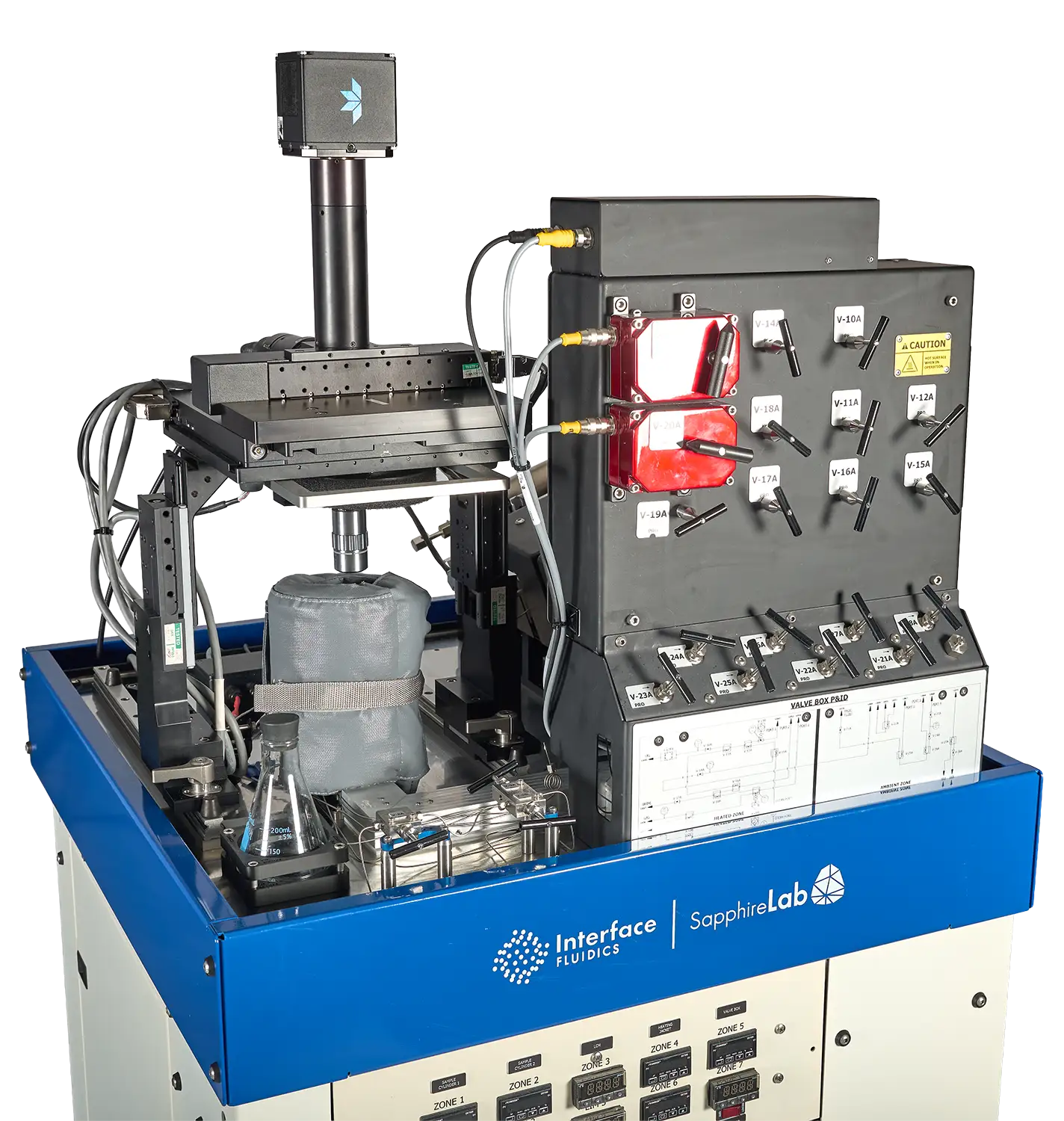
Each application runs on the SapphireLab® platform, our integrated system for extreme condition fluid analysis.

Our SapphireLab® Platform: A New Standard for Oil and Gas Laboratory Testing
Our SapphireLab® platform is designed to modernize Oil and Gas laboratory testing.
It supports high-pressure microfluidic experiments, modular chip integration, reduced laboratory footprint, and automation-ready workflows.
It serves both industry operators and universities conducting advanced microfluidics research and reservoir fluid analysis. Universities measure performance through the number and impact of the publications that they produce. A professor can hire students to either build new hardware and address the issues that arise from the design, or to generate novel research with a tool that they buy. It is an issue that is common in the software world: build or buy. (Obviously, we prefer they buy 😊)
Once installed, SapphireLab provides a platform where professors and students can explore different high-pressure phenomena on a platform that has been designed and tested to run at the conditions that they need. We offer a catalogue of 11 chips designs and also the ability for customers to make custom chips (that we fabricate). We have universities using our technology in Canada, The USA, Brazil, The UK, Denmark, and China.
Measurable Impact
Over the past ten years, we have completed countless microfluidic testing projects across 13 countries and deployed SapphireLab® to labs in the United States, Brazil, Columbia, Norway, and Thailand.
Operators have used reservoir-on-a-chip data to optimize chemical packages, identify incompatibilities early, improve enhanced oil recovery economics, refine flow assurance strategies, and validate simulation models.
The next decade will integrate microfluidic testing, automation, and data analytics at a deeper level. In the next 10 years, Interface will become the industry standard for testing chemical performance in hydraulic fracturing as well as minimum miscibility pressure and PVT properties. Chemical companies will rely on the products and services that we provide as a core part of their product development and marketing strategies. Oil and gas producers, lithium companies, and carbon sequestration operations will use Interface’s SapphireLab platform as the standard method to determine fluid properties like PVT as well as to address flow assurance issues.
Interface will be a core part of companies’ AI strategies as they start to require larger and larger volumes of structured data to inform the models they use to inform their chemical synthesis and reservoir simulations. Rapid feedback from microfluidic testing will be used in the field to determine fluid properties at the wellhead. Rapid testing will be coupled with reinforcement learning to allow for rapid chemical optimization.
Interface Fluidics will also expand into new markets that have the need for high-pressure and high-temperature testing. We have a plan here, but it is still top secret!
We’re Just Getting Started.
Ten years ago, we set out to change how fluids are measured in Oil and Gas. Today, our microfluidic testing supports flow assurance testing, Flowback testing, PVT testing, phase behaviour testing, and enhanced oil recovery screening across the industry.
We have built a platform that delivers extreme condition fluid analysis under true reservoir conditions.
Our last decade has been about teaching the world about the benefits of microfluidics for energy. The next decade is about applying the tools that we have built at scale and integrating into new technologies like AI.
Great chemistry deserves to be seen, and we are just getting started!