The Mixing S100 Chip includes a hexagonal homogeneous porous media and mixing rings and enables co-injection of fluids for on-chip mixing, and visualization and measurement of fluid performance. The chip can be used to study foam stability (understanding of how salinity, temperature, pressure, gas, and flow rate all impact foam performance) and foam mobility reduction factor (how foam reduces the mobility of the injection gas and impacts oil production).
The MMP S100 Chip, coupled with our Minimum Miscibility Pressure test procedure, enables fast determination of the miscibility conditions for a gas flooding operation. MMP measurements provide the lowest pressure at which the reservoir fluid and an injected fluid reach the miscibility condition at reservoir temperature. This critical measurement helps avoid unwanted early gas breakthrough, which would reduce oil recovery. The chip and the test procedure can also be used to determine the Minimum Miscibility Enrichment (MME).
The Regain S100 Chip, used with our Regain Conductivity test procedure, replicates the 20/40 mesh Proppant Pack test to help compare friction reducers and identify top performers. This chip includes a heterogeneous porous media with 36% porosity and 1.5 D permeability (calculated), along with 2 inlet channels and 1 outlet channel.
The Regain S200 Chip, used with our Regain Conductivity test procedure, replicates the 40/70 mesh Proppant Pack test to help compare friction reducers and identify top performers. This chip includes a heterogeneous porous media with 36% porosity and 620 mD permeability (calculated), along with 2 inlet channels and 1 outlet channel.
The Regain S300 Chip, used with our Regain Conductivity test procedure, replicates the 100 mesh Proppant Pack test to help compare friction reducers and identify top performers. This chip includes a heterogeneous porous media with 36% porosity and 100 mD permeability (calculated), along with 2 inlet channels and 1 outlet channel.
The SapphireLab Flowback Model by Interface Fluidics is a purpose-built microfluidic system for evaluating hydraulic fracturing fluid performance under realistic subsurface conditions. It provides a fast, standardized, and highly sensitive platform to screen individual chemistries or complete frac fluid packages. By replicating flow through controlled porous media, the Flowback Model delivers direct visualization and reproducible data on fluid interactions, compatibility, and performance. This enables operators and researchers to predict, prevent, and remediate flow assurance issues—such as scale formation, emulsions, or formation damage—while accelerating product development cycles. With results available in under a day, it allows rapid iteration, reducing startup risks and optimizing production outcomes with confidence.
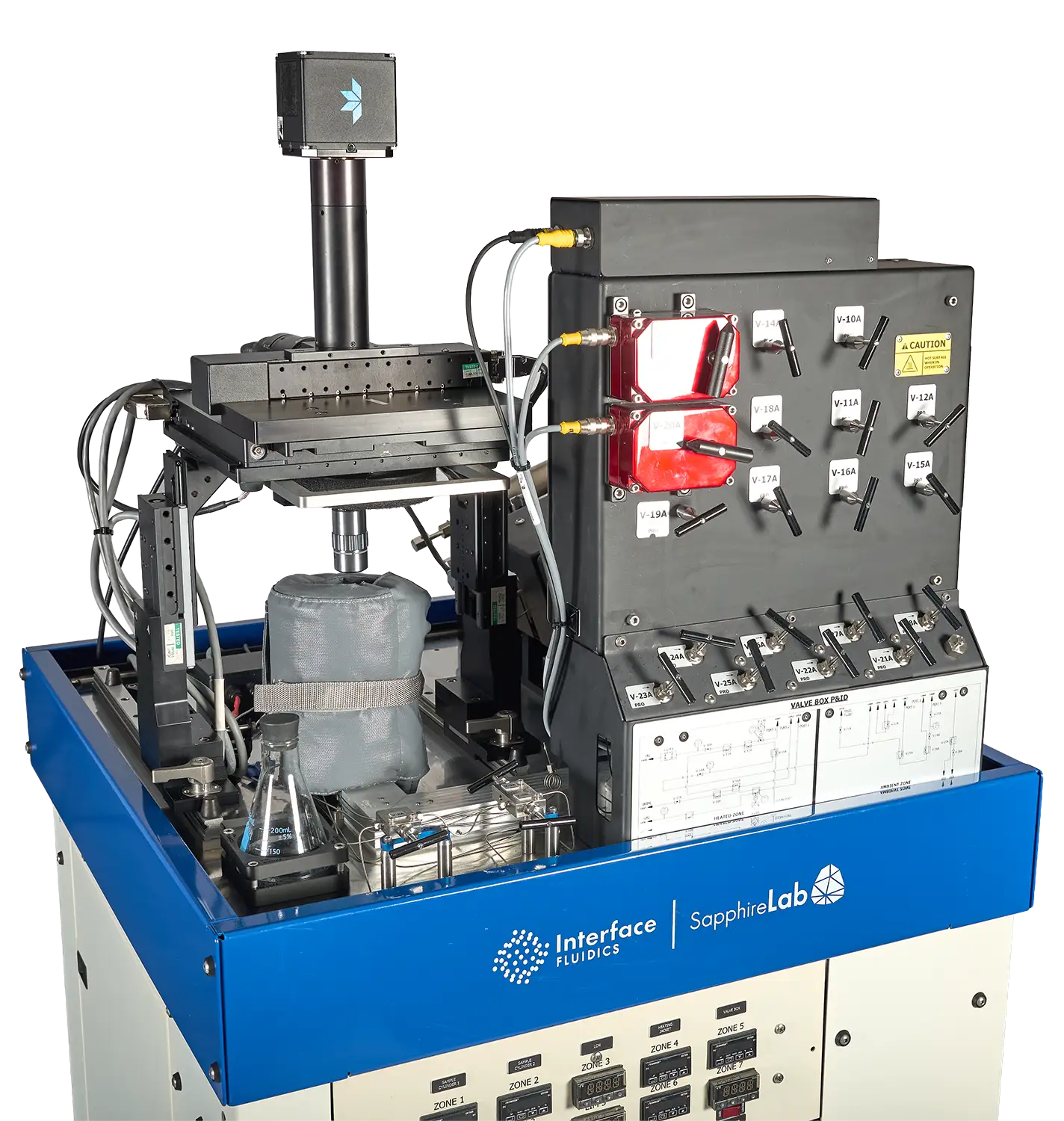
The SapphireLab Pro is Interface Fluidics’ flagship microfluidic system for high-pressure, high-temperature (HPHT) studies of reservoir fluids. Purpose-built for PVT and phase behavior analysis, they replicate reservoir conditions at the microscale to deliver direct visualization and quantitative measurements of bubble points, dew points, phase envelopes, and gas–oil interactions. Systems can also be configured to safely handle sour samples, ensuring compatibility with H₂S- and CO₂-rich reservoirs. In addition, the Pro series provides wax and asphaltene precipitation testing, extending its utility to complex production chemistry challenges. By combining advanced imaging with precise pressure-volume-temperature control, the Pro series accelerates decision-making in reservoir management, enhanced oil recovery (EOR), and production forecasting. Offering faster, more reliable, and repeatable results than conventional PVT laboratories, SapphireLab Pro and Pro Plus set the benchmark for reservoir fluid characterization.
The SapphireLab® Pro Plus are Interface Fluidics’ flagship microfluidic system for high-pressure, high-temperature (HPHT) studies of reservoir fluids. Purpose-built for PVT and phase behavior analysis, they replicate reservoir conditions at the microscale to deliver direct visualization and quantitative measurements of bubble points, dew points, phase envelopes, and gas–oil interactions. Systems can also be configured to safely handle sour samples, ensuring compatibility with H₂S- and CO₂-rich reservoirs. In addition, the Pro series provides wax and asphaltene precipitation testing, extending its utility to complex production chemistry challenges. By combining advanced imaging with precise pressure-volume-temperature control, the Pro series accelerates decision-making in reservoir management, enhanced oil recovery (EOR), and production forecasting. Offering faster, more reliable, and repeatable results than conventional PVT laboratories, SapphireLab Pro and Pro Plus set the benchmark for reservoir fluid characterization.
SapphireLab is a next-generation microfluidic laboratory system developed by Interface Fluidics for high-precision studies of fluid interactions under extreme pressure and temperature. The Storage Model is specifically engineered for CO₂ storage research and long-term fluid monitoring, providing unparalleled capability to simulate the complex conditions found in geological reservoirs. Designed for both academic and industrial applications, it allows science and engineering teams to replicate subsurface environments at the microscale, offering direct, real-time visualization of how fluids behave, interact, and evolve over time. By combining precision microfabrication, advanced imaging, and high-fidelity control of reservoir parameters, the Storage Model supports breakthrough insights into energy transition, carbon sequestration, and subsurface resource management.
The Swelling S100 Chip, coupled with our Swelling Factor test procedure, measures the expansion of oil as a result of injected gas. The Swelling Factor is the final volume divided by original volume at reservoir temperature. The test also measures the new saturation pressure of the oil and gas mixture (at complete dissolution of gas) and is used for tuning the equation of state model for gas injection EOR.
ULTRA HPHT STARTER KIT
A compact system designed to be a modern replacement for the PVT cell, slim tube and rising bubble apparatus. Provides ultimate flexibility, full heat tracing of the fluid path, live sample handling, and optional sour service.