
Interface's environmental contribution to carbon capture and storage solutions (CCUS)
Interface’s measurements provide key information for advancing CCUS projects.
Carbon Capture, Utilization and Storage (CCUS) is not a new idea in the oil and gas industry and has long been used to enhance oil recovery from a reservoir. Historically, the focus of CO2 injection has been on the economic benefits of more oil recovery. Today, utilization and storage of CO2 in a reservoir is quickly becoming a climate imperative and sequestering CO2 has become a priority in light of climate change issues. It is arguably essential to achieving the Paris Accord climate targets [IPCC – Paris].
Accessible MMP measurements
Understanding how CO2 and fluids interact in a reservoir is at the heart of CCUS. A key barrier to CCUS is the ability to measure relevant conditions that inform models and de-risk operations. Why is this hard?
One reason is that practical deployment of CCUS does not involve pure CO2. Major industrial CO2 streams have impurities — fingerprints of the industrial processes from which they were emitted. CCUS operations also employ additives to improve injectivity. These additives and impurities change the behaviour of the fluid in a reservoir. CCUS is a complex process involving complex mixtures under high temperature and pressure conditions in reservoir-specific conditions. Dealing with these challenges is exactly where Interface Fluidics contributes value.
Interface provides the analysis capabilities to resolve the potential for CO2 injection sub-surface. Current deployment of CCUS in the oil and gas industry is gated by a lack of relevant data — a direct result of slow and expensive testing methods. Measurement of minimum miscibility pressure (MMP) is a key to understanding and optimizing the injection of any gas into a reservoir. Traditional slim-tube tests to obtain the relevant data can cost $100,000 per data point and can take months to obtain.
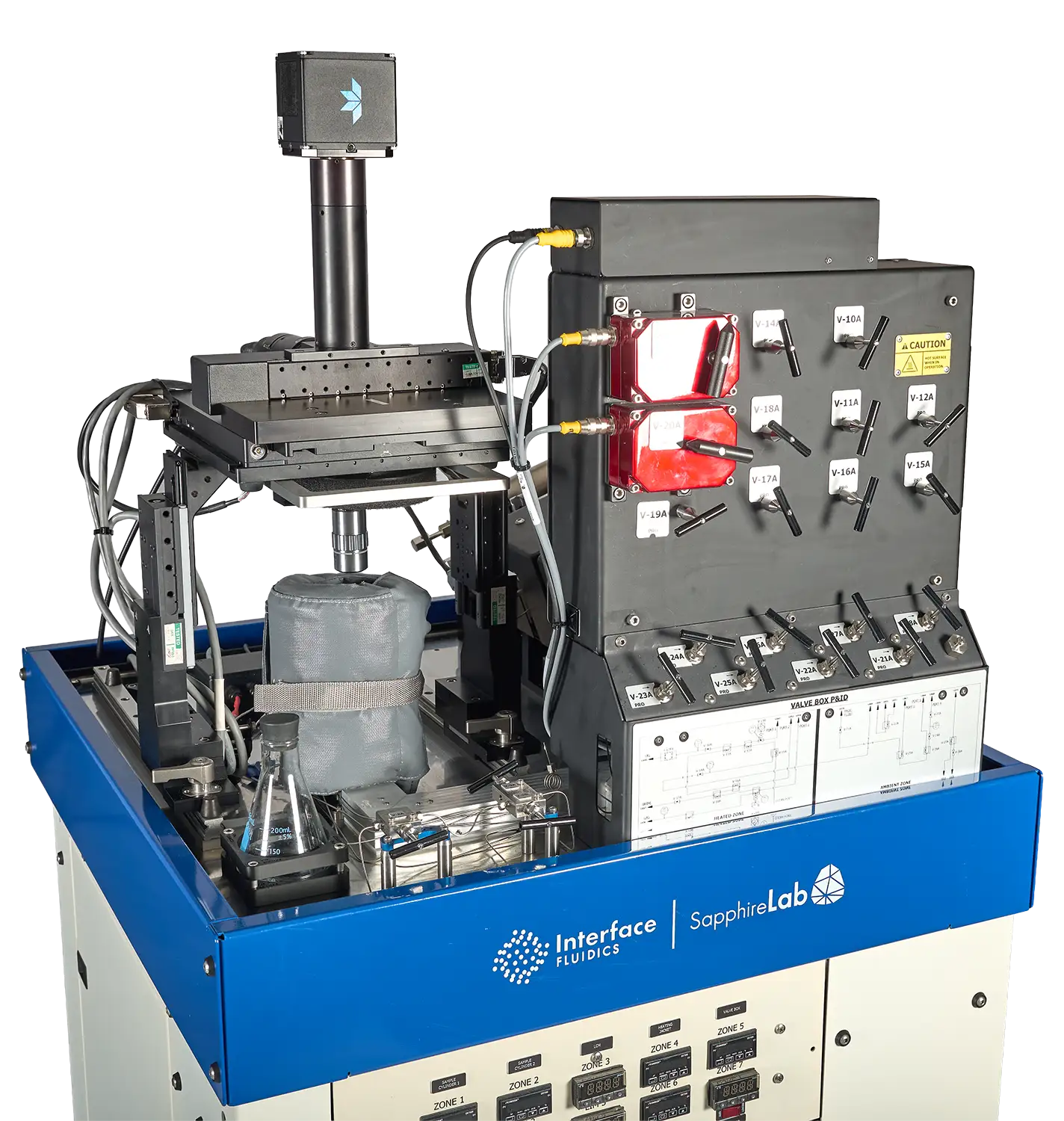
In collaboration with Equinor, Interface developed a microfluidic device and testing methodology that provides the same data as the slim-tube test. Interface’s results were validated against minimum miscibility pressure for three live oil samples and selected gas mixtures derived from traditional slim-tube tests and found to be similar to within 2.8%. Compared to traditional slim-tube testing, Interface’s technology reduced measurement time by over 95%, reduced sample volume required by 99%, and eliminated the need for mathematical interpolation of results by increasing the number of measurements taken per sample by 10-20X.
Based on the exciting work Interface is doing in the area of reservoir PVT analysis, we are confident we will have a positive impact on enabling more CCUS projects globally.
More information on Interface’s MMP and PVT data solutions.